The custom rain poncho order has a way of going wrong precisely because it feels simple. It is usually placed late, under weather pressure, by someone who is buying ponchos for the first time and treating them as a commodity. They are not quite a commodity, and the gap between a good order and a bad one shows up on the day it rains in front of your crowd. Here are the mistakes that cost the most, and how to avoid each one.
Mistake 1: Picking disposable or reusable on sticker price alone
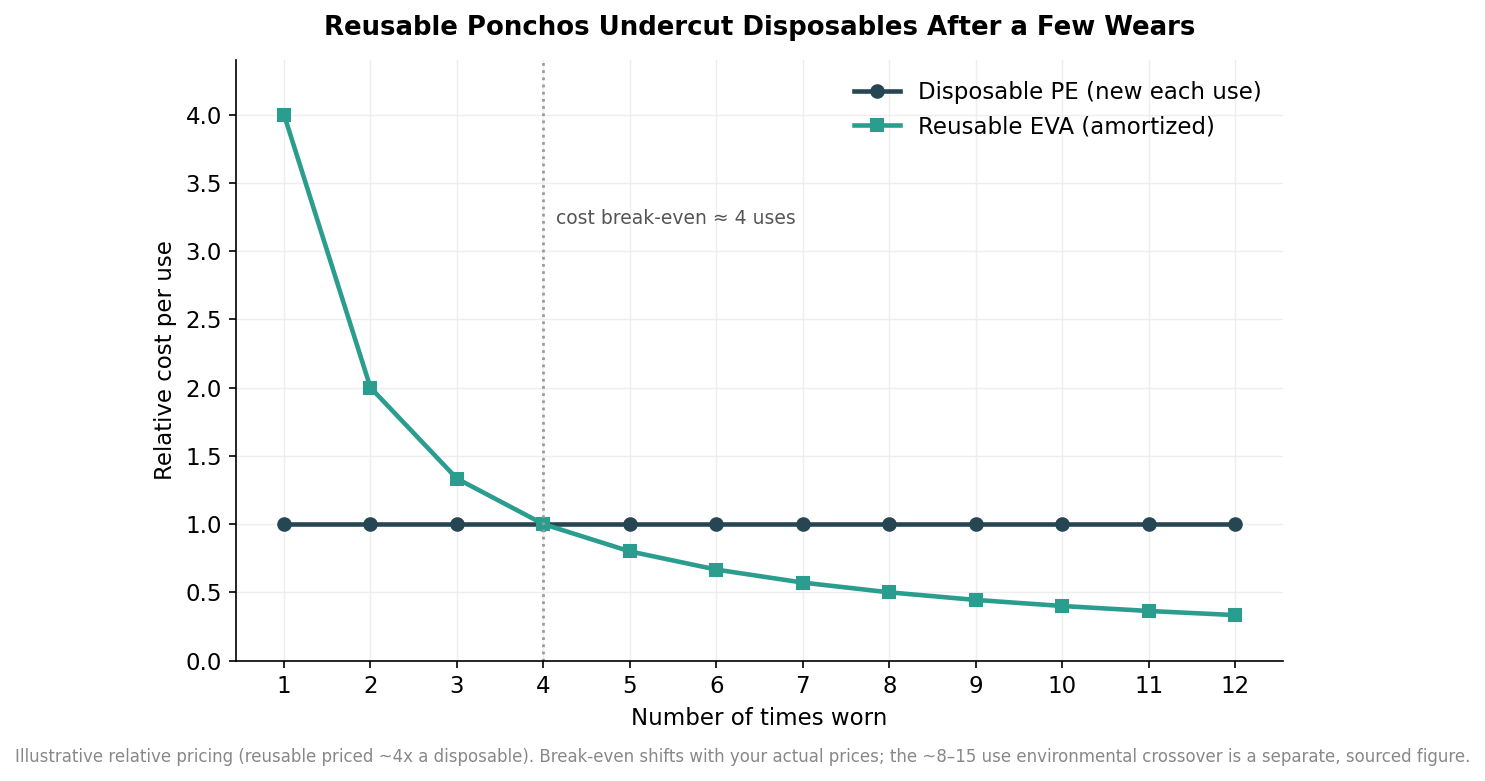
The cheapest poncho per unit is almost always thin single-use polyethylene, and for a one-time giveaway to a large crowd that is often the correct answer. PE has the lowest cost-per-wear of any option when the wear count is one. The mistake is applying that logic to a poncho people are meant to keep and reuse. A reusable EVA or PEVA poncho costs more up front, but amortized across a season of games or a multi-day festival its cost per use drops below the disposable quickly, typically after only a handful of wears. There is an environmental version of the same crossover: EVA generally becomes the lower-impact choice than repeatedly handing out PE after roughly 8 to 15 uses. Decide first whether this is a keepsake or a throwaway, because that single call drives everything downstream. A team handing out ponchos at a single rained-out game is buying disposables; a venue that expects to reissue the same ponchos across a season, or a brand that wants attendees to carry the item home and wear it again, is buying reusable and should stop comparing it to the disposable’s unit price at all.
Mistake 2: Guessing at thickness
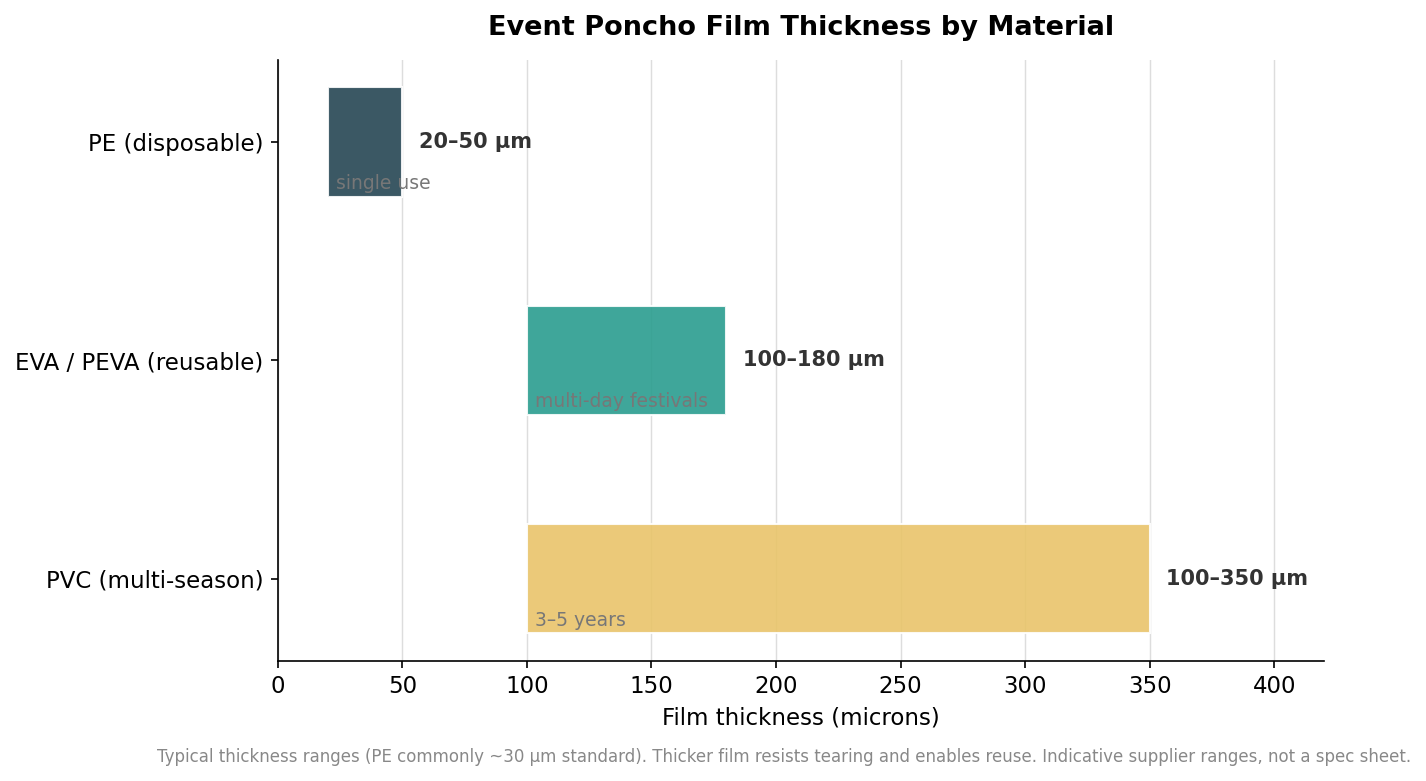
Poncho film is measured in microns (thousandths of a millimeter), and buyers routinely confuse the scale or accept whatever the supplier defaults to. The practical ranges are worth knowing. Disposable PE runs about 0.02 to 0.05 mm, roughly 20 to 50 microns, with 0.03 mm a common standard. Reusable EVA and PEVA sit far heavier at 100 to 180 microns, and PVC heavier still at 100 to 350 microns for gear meant to last years. Thickness is not vanity: a 30-micron emergency poncho will shed a downpour once but tears easily if someone tries to fold and reuse it, while a 150-micron EVA survives a bag, a pocket, and a second day. Spec the micron figure explicitly rather than ordering “thick” or “heavy duty” and hoping.
Mistake 3: Under-ordering for the actual crowd
Order quantity is where optimism does the most damage. Planners tend to buy ponchos as if only a fraction of attendees will want one, which holds right up until it actually rains, at which point uptake among exposed, seated, or queuing attendees climbs toward everyone. Running short is the worst outcome available: the people without a poncho are wet and unhappy, and the branded item you paid to distribute is conspicuously absent from exactly the moment it would have been photographed most. Plan coverage against the portion of your crowd that will genuinely be exposed to weather, not against a hopeful take rate, and build in a margin. Overshooting by a sensible buffer costs pennies per unit; running out costs the whole point of the exercise.
Mistake 4: Believing “one size fits all” literally
Adult ponchos are generally cut as a generous one-size garment, on the order of 50 by 40 inches, which does drape over most adult body types and over a backpack or stadium seat. The error is assuming that single size serves a mixed audience. At a family event, a marathon finish line, or a school function, an adult-sized poncho on a small child is a tripping and overheating hazard, not a convenience. If children are in your crowd, order age-banded kids sizes as a separate line rather than stretching one cut across everyone. The same goes for events with a lot of layering or bulky coats in cold rain, where a roomier cut earns its keep. Race organizers hit a related version of this: a poncho meant to go over a finisher who is still wearing a hydration vest or a bib needs more room than a general-admission giveaway, so match the cut to what people will actually be wearing underneath it.
Mistake 5: Ignoring lead time, minimums, and the print itself
Rain is a deadline you do not control, and custom ponchos are not an overnight product. Plain PE production commonly runs 2 to 3 weeks, custom colors stretch that to 4 to 8 weeks, and adding your branding layers on another 2 to 4 weeks on top. Minimums matter too: PE orders often start around 1,000 to 3,000 units, while reusable EVA and PVC typically begin at 3,000 to 5,000. Back the whole timeline out from your event date, not from when you happen to remember. And when you do specify the print, think about where it lands on a worn poncho: a logo on the chest or a repeated pattern reads far better in a crowd than a single mark that ends up folded into an armpit. Confirm the printable area, the number of colors, and the placement on the body as worn, so the branding you paid for is the branding people actually see.
None of these mistakes require expertise to avoid, only a few decisions made deliberately instead of in a rush. Settle disposable versus reusable, name the thickness in microns, size the order to the exposed crowd, add kids sizes when children are present, and start early enough to clear production, minimums, and branding. Get those five right and a rainy day becomes your best branded-impressions day of the year instead of a scramble.